
ALPROLIX® has demonstrated effective bleed protection in all age groups1–4
The efficacy and tolerability of ALPROLIX has been demonstrated in four key clinical trials:1–4
- B-LONG: Phase 3 trial in previously treated adults and adolescents (male) ≥12 years of age with severe haemophilia B (N=123). The efficacy primary endpoint was per-patient ABR*1
- Kids B-LONG: Phase 3 trial in previously treated children (male) <12 years of age with severe haemophilia B (N=30). The primary endpoint was inhibitor development2
- PUPs B-LONG: Phase 3 trial in previously untreated patients (male) <18 years of age with haemophilia B (N=33). The primary endpoint was inhibitor development3
- B-YOND: Extension study in previously treated patients who completed B-LONG (N=93) or Kids B-LONG (N=27). The primary endpoint was inhibitor development4
*Annualised bleeding rates (number of bleeding episodes per participant divided by the number of days in the efficacy period, multiplied by 365.25) were calculated with the use of the negative binomial regression model to control for participantsʼ time in the study.1
Prophylaxis
Acute bleed control and perioperative outcomes can be found further down.

B-LONG1
Per-patient ABR (95% CI):
- Weekly prophylaxis (n=61): 3.12 (2.46–3.95)
- Individualised prophylaxis (n=26): 2.40 (1.67–3.47)
- On-demand treatment (n=27): 18.67 (14.01–24.89)
Primary safety endpoints were inhibitor development and adverse events (AE): No inhibitors were detected. Among the participants in groups 1, 2, and 3, 73.9% (n=88/119) had at least one AE. The most common AE (incidence ≥5% in a pooled analysis of all three groups) were nasopharyngitis, influenza, arthralgia, upper respiratory tract infection, headache, and hypertension. The majority of these events were judged by the investigators to be unrelated or unlikely to be related to treatment with ALPROLIX.1
B-YOND5
Median overall ABR (IQR):
- Weekly prophylaxis (n=51): 2.3 (0.4–5.2)
- Individualised prophylaxis (n=31): 1.9 (0.8–4.0)
The primary endpoint in B-YOND was inhibitor development; no inhibitor development was reported.4

Kids B-LONG2
Median overall ABR (IQR) on weekly prophylaxis:
- <6 years old (n=15): 1.1 (0.0–2.9)
- 6–11 years old (n=15): 2.1 (0.0–4.2)
The primary endpoint in Kids B-LONG was inhibitor development; no inhibitor development was reported.2
B-YOND4,5
Median overall ABR (IQR) on weekly prophylaxis:
- <6 years old (n=13): 1.0 (0.0–2.3)
- 6–11 years old (n=10): 1.1 (0.5–2.3)

PUPs B-LONG3
Median overall ABR (IQR) on weekly prophylaxis:
- <18 years old (n=28): 1.24 (0.0–2.49)
The primary endpoint in PUPs B-LONG was inhibitor development: 3.57% (0.09–18.35) at ≥10 EDs (n=28), 3.70% (0.09–18.97) at ≥20 EDs (n=27), 4.55% (0.12–22.84) at ≥50 EDs (n=22).*3
*One patient (3.03% [95% CI: 0.08–15.76]) receiving prophylaxis developed a low-titre inhibitor (≥0.60 to <5.0 BU/mL) after 11 EDs, as well as serious hypersensitivity which resulted in withdrawal from the study. No high-titre inhibitors were detected in any patient.3
Treating bleeds on-demand
ALPROLIX offered acute bleed control across all age groups1–3
Most bleeds resolved with just one injection:1–3
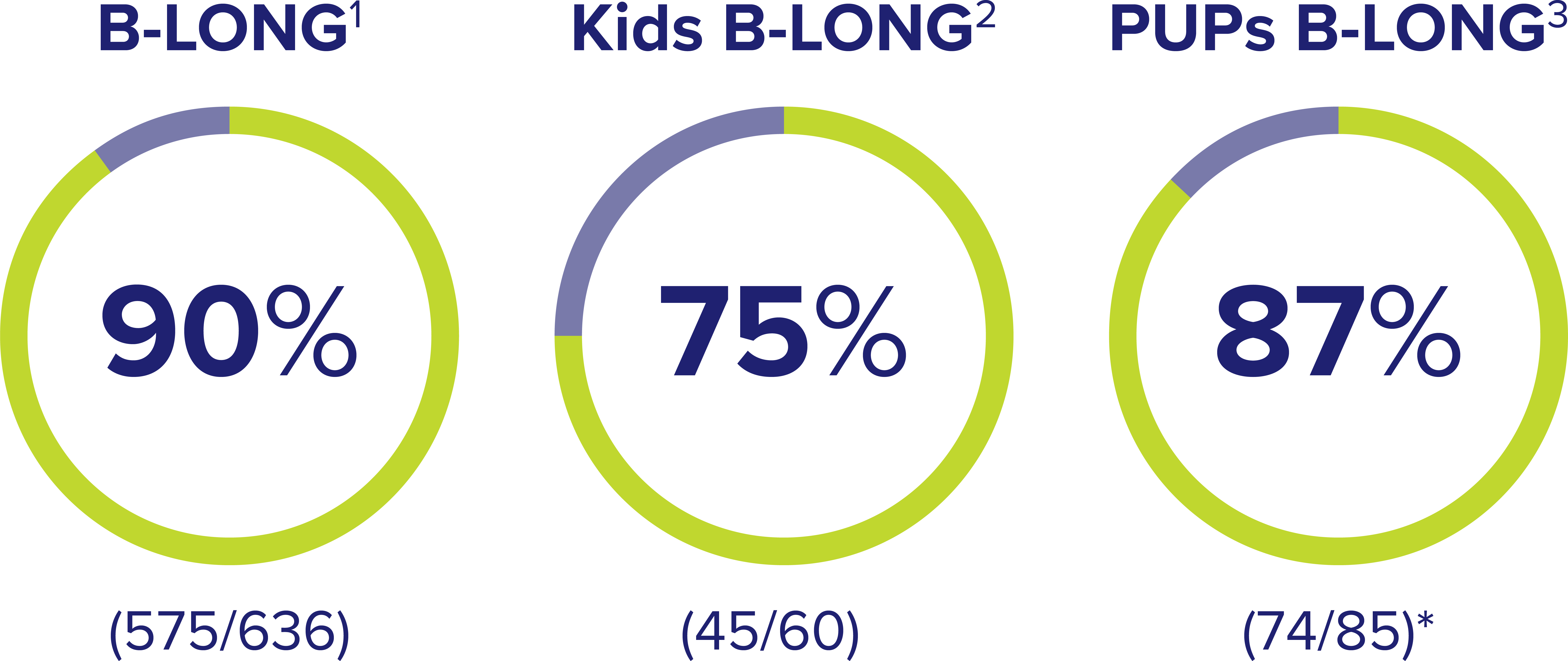
*Percentage calculated as an average for on-demand and prophylaxis outcomes: n=23/27 (85%) of 27 bleeding episodes in on-demand group and n=51/58 (88%) of 58 in the prophylaxis group.3
In at least 84% of bleeds assessed, response to first injection was rated as 'excellent' or 'good':2,3,8
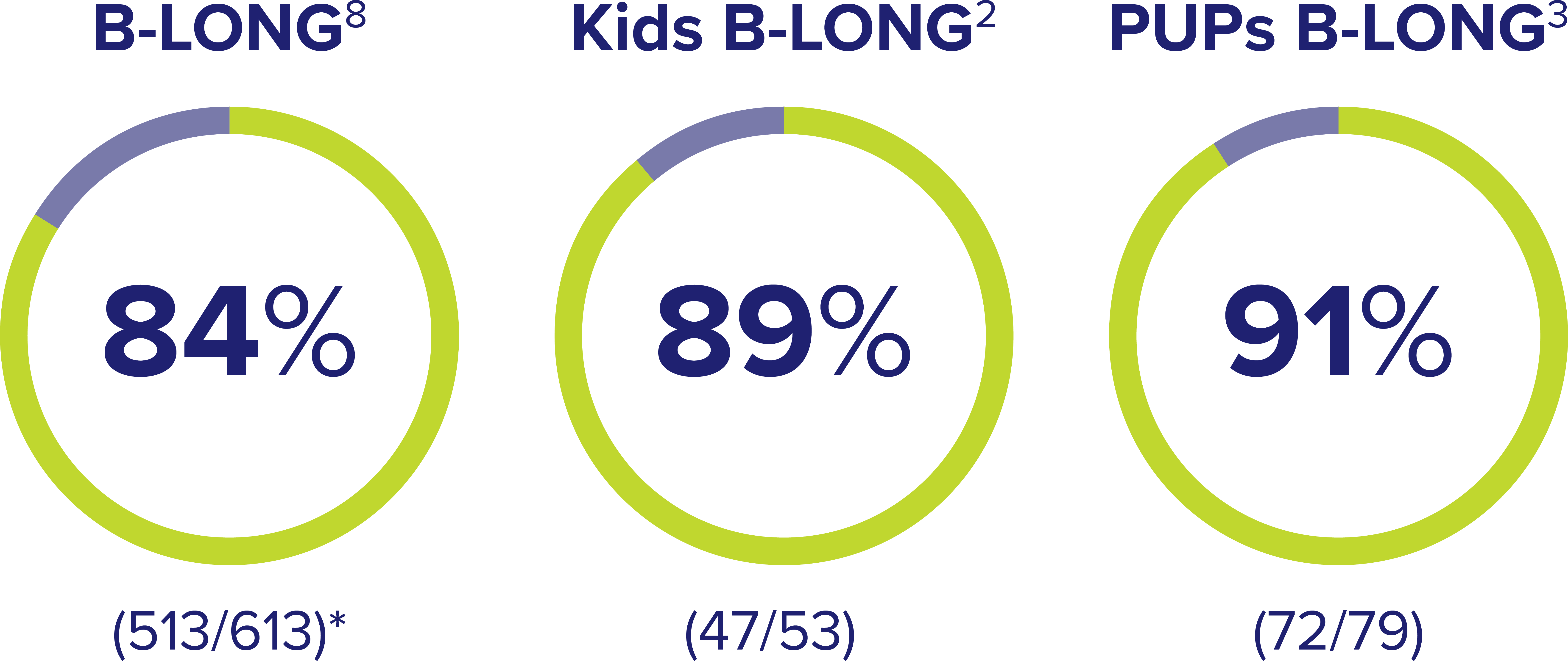
Response to bleed was assessed by patient/caregiver.2,3,8
*Reported separately to the B-LONG study publication.8
Perioperative treatment
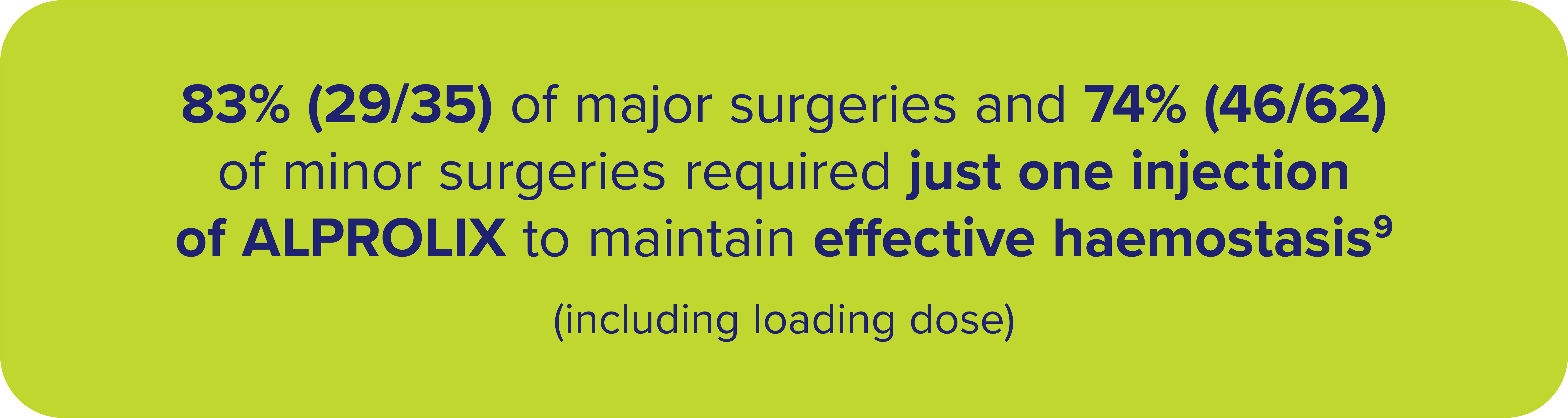
ALPROLIX demonstrated effective haemostasis management in major and minor surgeries9
ALPROLIX has been used in 97 surgical procedures in a clinical trial setting (prospective data collected from patients enrolled in B-LONG, Kids B-LONG and B-YOND who underwent major or minor surgery).9
ABR, annualised bleeding rate; AsBR, annualised spontaneous bleeding rate; CI, confidence interval; BU, Bethesda unit; ED, exposure day; IQR, interquartile range.
References
1. Powell JS, et al. N Engl J Med. 2013;369(24):2313–2323. 2. Fischer K, et al. Lancet Haematol. 2017;4(2):e75–e82. 3. Nolan B, et al. Blood Adv. 2021;5(13):2732–2739. 4. Pasi KJ, et al. Haemophilia. 2020;26(6):e262–e271. 5. Pasi KJ, et al. Haemophilia. 2020;26(6):e262–e271 (Suppl). 6. ALPROLIX UK Summary of Product Characteristics. 7. ALPROLIX EU Summary of Product Characteristics. 8. ALPROLIX Package Insert. FDA. Revised May 2023. 9. Chowdary P, et al. Res Pract Thromb Haemost. 2022;6(5):e12760.
ALPROLIX is indicated for the treatment and prophylaxis of bleeding in patients with haemophilia B (congenital factor IX deficiency). ALPROLIX can be used for all age groups.6,7
Adverse events should be reported. Reporting forms and information can be found, for United Kingdom: via the Yellow Card Scheme at www.mhra.gov.uk/yellowcard or search for MHRA Yellow Card in the Google Play or Apple App Store. For Ireland: via HPRA Pharmacovigilance website www.hpra.ie. Adverse events should also be reported to Swedish Orphan Biovitrum Ltd by email at [email protected] or by calling +44 (0) 800 111 4754. |