

The only EHL FIX to use Fc fusion technology to extend half-life1–6
ALPROLIX is a single molecule of FIX fused to the Fc domain of human IgG1. Fc fusion enables ALPROLIX to bind to the neonatal Fc receptor, protecting it from lysosomal degradation.1,2 Fc eventually degrades naturally and does not accumulate in the body.7
ALPROLIX may mirror the distribution of endogenous FIX8–11
Preclinical data indicate ALPROLIX may distribute to the extravascular space in a similar manner to natural FIX.8,11

PK data in humans indicates that ALPROLIX has a high volume of distribution,1,2which may support its ability to access the extravascular space, as demonstrated in preclinical research and a population PK study.8,12
ALPROLIX vs natural FIX distribution8

Additional preclinical evidence suggests FIX in the extravascular space may support haemostasis alongside plasma FIX.11
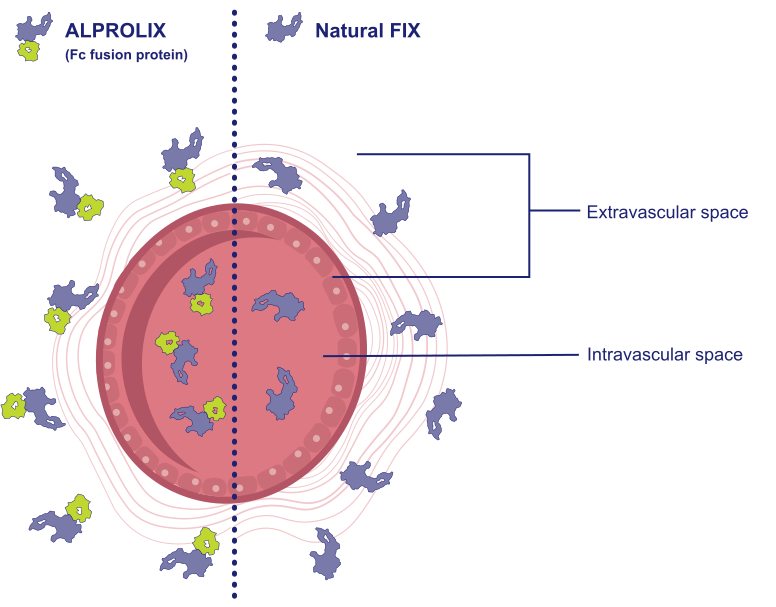
Adapted from van der Flier A, et al. 2023.8
Unlike with FVIII,13 trough levels may not be a predictor of bleed protection in haemophilia B11
MAIC analysis of ALPROLIX and rIX-FP prophylaxis
The aim of the following study was to (indirectly) compare the efficacy of ALPROLIX and rIX-FP using MAIC methodology. Individual patient data for ALPROLIX (B-LONG study) were matched to aggregated data for rIX-FP (PROLONG-9FP study) followed by statistical comparison for estimated ABR. Data were analysed according to treatment regimen prior to study entry: prior prophylaxis (ALPROLIX, n=48; rIX-FP, n=40) or prior episodic treatment (n=43 and n=19, respectively). MAIC was performed in accordance with NICE DSU guidance. Adjusted ABRs were estimated using a weighted Poisson regression model accounting for overdispersion and compared using IRRs.14
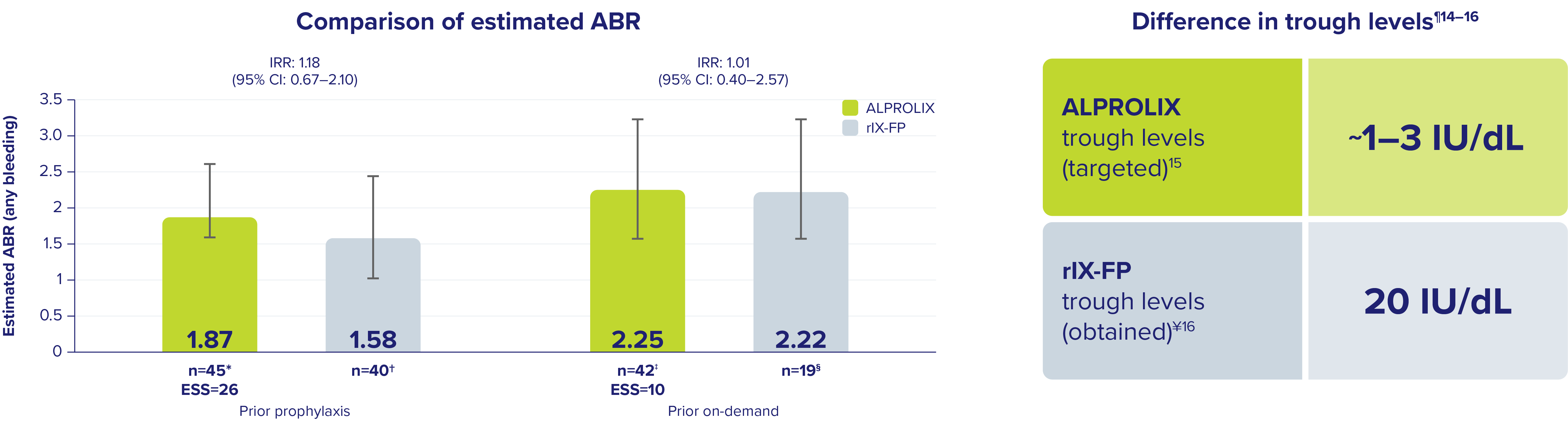
Adapted from Astermark J, et al. 2021.14
Estimated ABR, any bleeding, after matching for all baseline variables reported in both studies (age, weight, prior bleeds and ethnicity (proportion of white patients)). *Data missing for ABR and treatment duration (n=3). †Data from PROLONG-9FP.14 ‡Data missing for ABR and treatment duration (n=2). §Data from PROLONG-9FP, of the 23 patients receiving prior on-demand only 19 patients transitioned to prophylaxis.14 ¶Targeted and obtained trough levels in B-LONG (APLROLIX) and PROLONG-9FP (rIX-FP) respectively.15,16 ¥Mean trough activity of 20 IU/dL and 12 IU/dL was maintained with rIX-FP prophylaxis using 40 IU/kg weekly or 75 IU/kg every 14 days, respectively.16
No direct head-to-head comparisons have been conducted between these treatments.
MAIC analysis of ALPROLIX and N9-GP prophylaxis
The aim of the following study was to (indirectly) compare the efficacy of ALPROLIX and N9-GP, using a MAIC of efficacy data from the pivotal Phase 3 B-LONG (ALPROLIX) and PARADIGM 2 (N9-GP) clinical trials . Individual patient data (n=87) from the weekly and individualised interval prophylaxis arms of the B-LONG trial were matched to aggregated data (n=29) from the 40 IU/kg once-weekly prophylaxis arm of PARADIGM 2, followed by statistical comparison for estimated ABR. Adjusted ABRs for ALPROLIX and N9-GP were estimated using a weighted Poisson regression model accounting for overdispersion and compared using IRRs. MAIC was performed in accordance with NICE DSU guidance.17
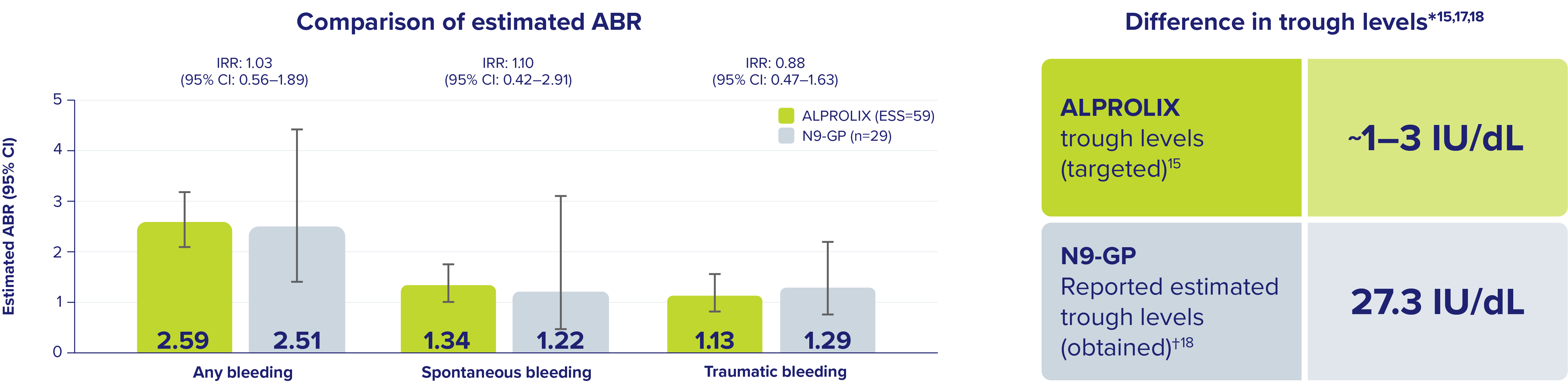
Adapted from Mancuso ME, et al. 2023.17
Comparison of estimated annualised bleeding rates after matching for baseline variables (age, weight, prior prophylaxis, White race, Asian ethnicity and the presence of target joints at baseline).17
*Targeted and obtained trough levels in B-LONG (ALPROLIX) and PARADIGM 2 (N9-GP) respectively.15,18 † Estimated mean FIX trough activity on 40 IU/kg.18
No direct head-to-head comparisons have been conducted between these treatments.
ABR, annualised bleeding rate; CI, confidence interval; DSU, decision support unit; EHL, extended half-life; Fc, crystallisable fragment; FIX, factor IX; FVIII, factor VIII; IgG1, immunoglobulin G1; IU, international unit; IRR, incidence rate ratios; MAIC, matching-adjusted indirect comparison; NICE, National Institute for Health and Care Excellence; N9-GP, nonacog beta pegol; rFIX-FP, recombinant factor IX albumin fusion protein.
References
1. ALPROLIX UK Summary of Product Characteristics. 2. ALPROLIX EU Summary of Product Characteristics. 3. Refixia UK Summary of Product Characteristics. 4. Refixia EU Summary of Product Characteristics. 5. Idelvion UK Summary of Product Characteristics. 6. Idelvion EU Summary of Product Characteristics. 7. Shapiro A. Expert Opin Biol Ther. 2013;13(9)1287–1297. 8. van der Flier A, et al. Blood Coagul Fibrinolysis. 2023;36(6):353–363. 9. Iorio A, et al. Thromb Haemostat. 2017;117(6):1023–1030. 10. Morfini M. J Clin Med. 2017;6(3):35. 11. Mann DM, et al. Haemophilia. 2021;27(3):332–339. 12. Diao L, et al. Clin Pharmacokinet. 2014;53(5):467–477. 13. Jimenez-Yuste V, et al. Blood Transfus. 2014;12(3):314–319. 14. Astermark J, et al. J Blood Med. 2021;12:613–62. 15. Powell JS, et al. N Engl J Med. 2013;369(24):2313–2323. 16. Santagostino E, et al. Blood. 2016;127(14):1761–1769. 17. Mancuso ME, et al. J Blood Med. 2023;14:427–434. 18. Collins PW, et al. Blood. 2014;124(26):3880–3886.
ALPROLIX is indicated for the treatment and prophylaxis of bleeding in patients with haemophilia B (congenital factor IX deficiency). ALPROLIX can be used for all age groups.5,6
Adverse events should be reported. Reporting forms and information can be found, for United Kingdom: via the Yellow Card Scheme at www.mhra.gov.uk/yellowcard or search for MHRA Yellow Card in the Google Play or Apple App Store. For Ireland: via HPRA Pharmacovigilance website www.hpra.ie. Adverse events should also be reported to Swedish Orphan Biovitrum Ltd by email at [email protected] or by calling +44 (0) 800 111 4754. |