

Extended dosing with ALPROLIX prophylaxis could alleviate injection treatment burden vs SHL FIX prophylaxis1–5
In addition to prophylaxis, ALPROLIX can also be used for the treatment of acute bleeds and for perioperative management (dosing information can be found later in this section).1,2
Convenient starting regimens for prophylaxis*1,2

- For adults and adolescents 12 years or older, start on 50 IU/kg once weekly
- For children younger than 12 years of age, start on 50–60 IU/kg once weekly†


- Potential for ≥14-day dosing for well-controlled patients on 10-day regimens. This applies to adults and adolescents 12 years or older only
ALPROLIX offers a wide range of vial sizes to support facilitation of personalised dosing regimens1,2,6–9
ALPROLIX dosing information1,2
For acute bleed control
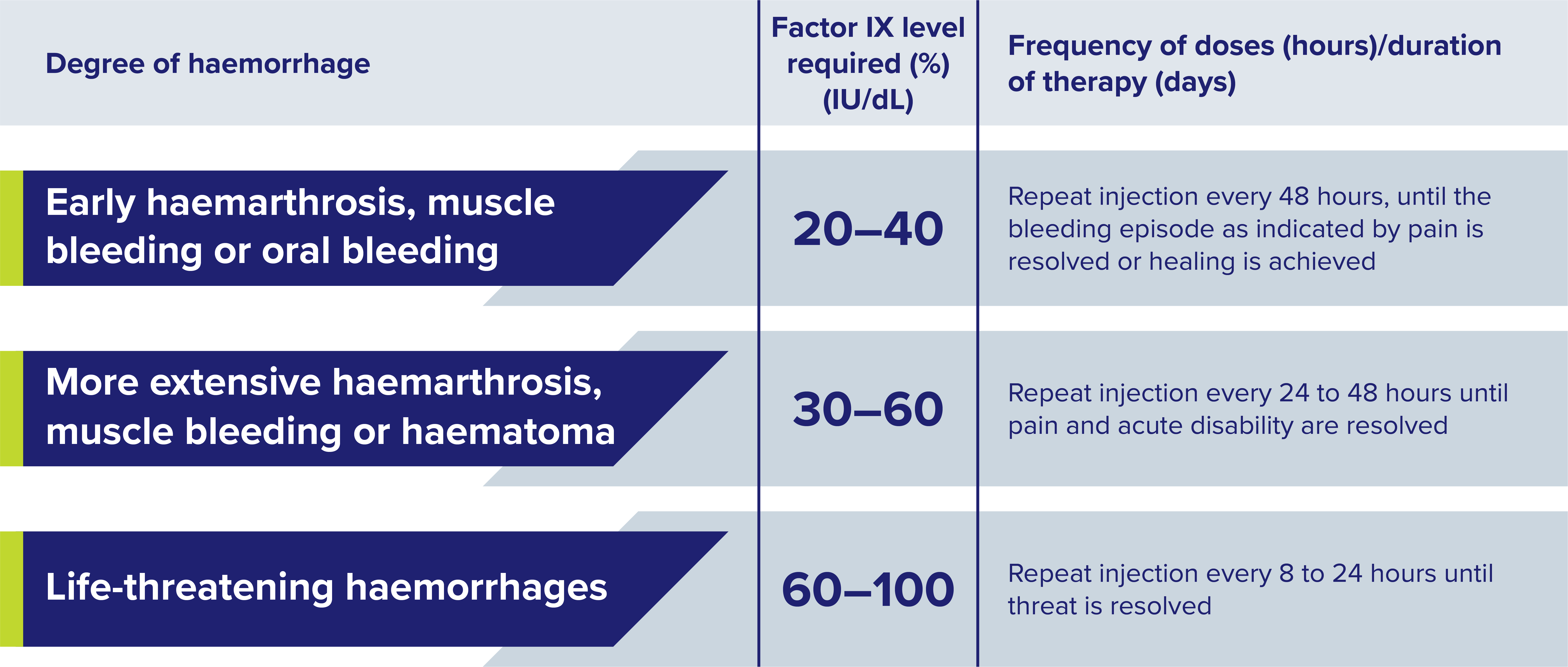
- Factor IX activity should not fall below the given plasma activity level (in % of normal or IU/dL) in the corresponding period
- The calculation for required dose of ALPROLIX® is based on the empirical finding that 1 International Unit (IU) factor IX per kg body weight raises the plasma factor IX activity by 1% of normal activity (IU/dL)
- The required dose is determined using the following formula: body weight (kg) × desired factor IX rise (%) (IU/dL) × {reciprocal of observed recovery (IU/kg per IU/dL)}
- The amount to be administered and the frequency of administration should always be oriented to the clinical effectiveness in the individual case. If a repeat dose is required to control the bleed, the prolonged half-life of ALPROLIX should be taken into account. The time to peak activity is not expected to be delayed
For surgery
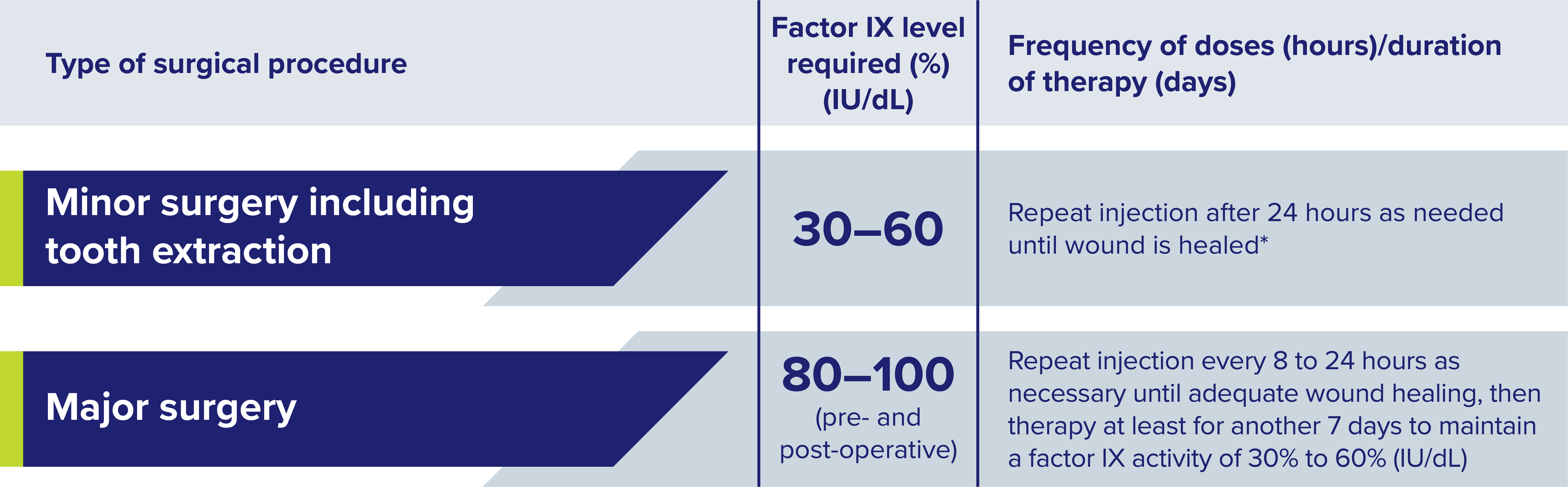
- Factor IX activity should not fall below the plasma activity levels shown below over the course of the corresponding period
- The calculation for required dose of ALPROLIX® is based on the empirical finding that 1 International Unit (IU) factor IX per kg body weight raises the plasma factor IX activity by 1% of normal activity (IU/dL)
- The required dose is determined using the following formula: body weight (kg) × desired factor IX rise (%) (IU/dL) × {reciprocal of observed recovery (IU/kg per IU/dL)}
- The amount to be administered and the frequency of administration should always be oriented to the clinical effectiveness in the individual case. If a repeat dose is required to control the bleed, the prolonged half-life of ALPROLIX should be taken into account. The time to peak activity is not expected to be delayed
*In some patients and circumstances, the dosing interval can be prolonged up to 48 hours.1,2
Please refer to the SmPC for complete dosing information.
*For long-term prophylaxis against bleeding, the recommended starting regimens for adults or adolescents ≥12 years old are either 50 IU/kg once weekly, adjusting the dose based on individual response, or 100 IU/kg once every 10 days, adjusting the interval based on individual response. Some patients who are well-controlled on a once every 10 days regimen might be treated on an interval of 14 days or longer. The highest recommended dose for prophylaxis is 100 IU/kg.1,2
†Higher or more frequent doses may be required in children below the age of 12 years. The highest recommended dose for prophylaxis is 100 IU/kg.1,2
FIX, factor IX; IU, international unit; SHL, standard half-life.
References
1. ALPROLIX 250 IU UK Summary of Product Characteristics. 2. ALPROLIX EU Summary of Product Characteristics. 3. Thornburg C., Duncan N. Patient Pref Adherence. 2017;11:1677–1686. 4. BeneFIX UK Summary of Product Characteristics. 5. BeneFIX EU Summary of Product Characteristics. 6. ALPROLIX 500 IU UK Summary of Product Characteristics. 7. ALPROLIX 1000 IU UK Summary of Product Characteristics. 8. ALPROLIX 2000 IU UK Summary of Product Characteristics. 9. ALPROLIX 3000 IU UK Summary of Product Characteristics.
ALPROLIX is indicated for the treatment and prophylaxis of bleeding in patients with haemophilia B (congenital factor IX deficiency). ALPROLIX can be used for all age groups.1,2
Adverse events should be reported. Reporting forms and information can be found, for United Kingdom: via the Yellow Card Scheme at www.mhra.gov.uk/yellowcard or search for MHRA Yellow Card in the Google Play or Apple App Store. For Ireland: via HPRA Pharmacovigilance website www.hpra.ie. Adverse events should also be reported to Swedish Orphan Biovitrum Ltd by email at [email protected] or by calling +44 (0) 800 111 4754. |