

Bleeds still occur despite current prophylaxis12–14
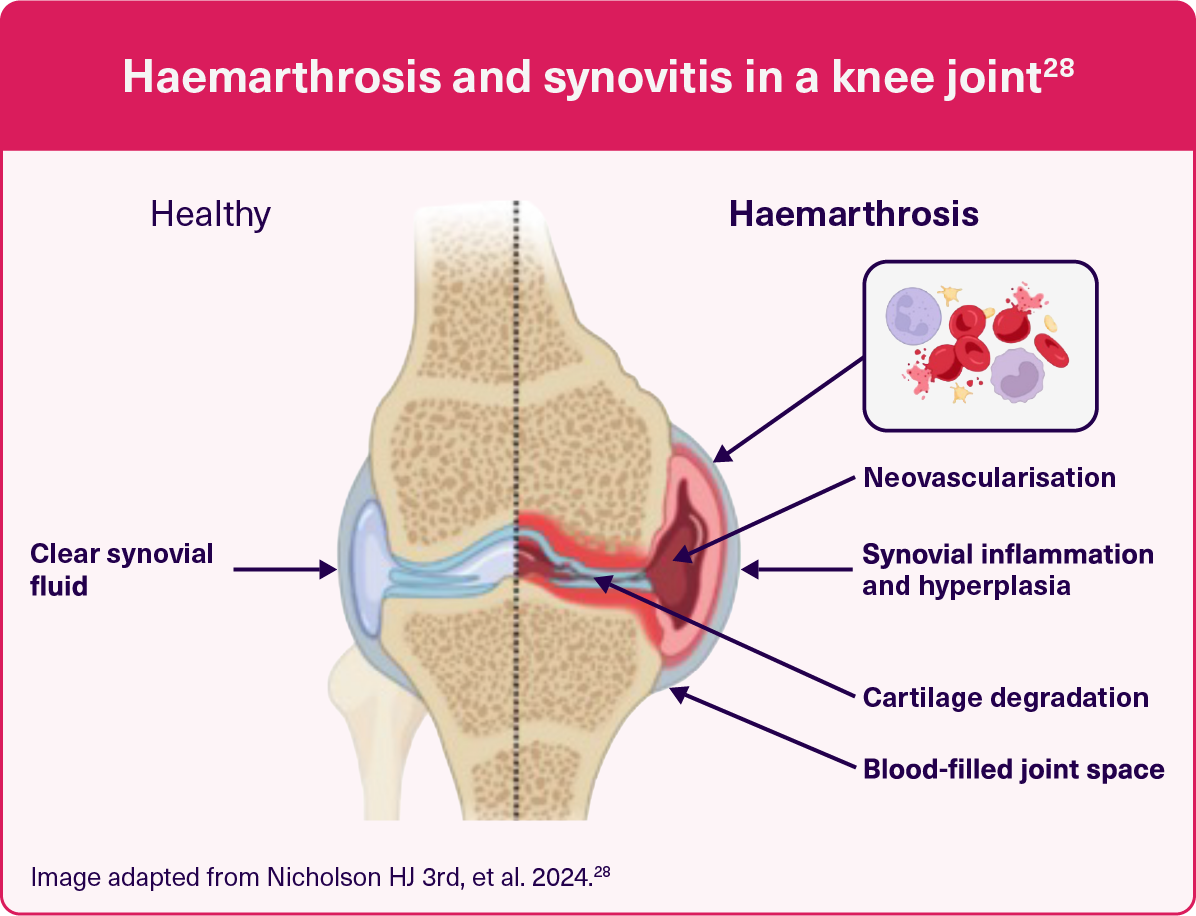
Clinical and real-world evidence indicate breakthrough bleeds continue to occur despite prophylaxis, with a significant impact on patients' lives. Repeated joint bleeds can lead to chronic pain and impaired mobility, and affecting overall quality of life.12
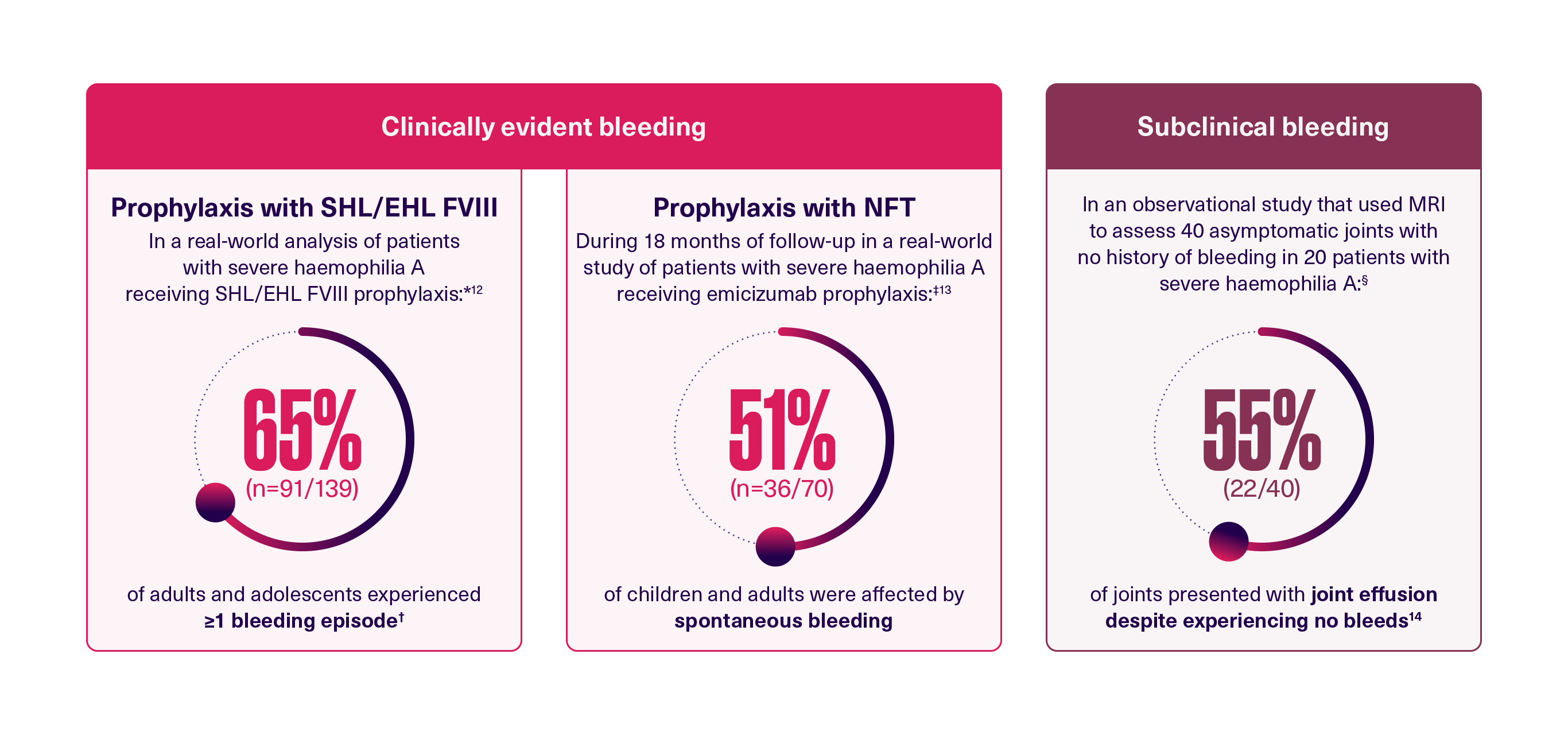
*Prospective, observational study conducted across 45 sites in 17 countries assessing real-world treatment outcomes of previously treated patients aged ≥12 years with severe haemophilia A receiving FVIII replacement therapy.12 †A bleeding episode was defined from the onset of the first sign of bleeding until ≤72 hours after the last injection to treat the bleeding episode.12 ‡Prospective observational cohort study from the Israeli National Hemophilia Centre, evaluating breakthrough bleeding patterns in patients aged 1 month to 74.9 years with severe haemophilia A treated with emicizumab. The development of at least one spontaneous bleeding episode during treatment was a binary outcome variable.13 §Cross-sectional imaging study conducted at Italian haemophilia and radiology centres, evaluating MRI and ultrasound findings in clinically “healthy” joints of young patients (aged 22.45±2.72) with severe haemophilia A. Of the 20 patients, 14 were receiving secondary prophylaxis and six were treated on-demand.14
HEAD-US evaluates joint health using ultrasound7
HEAD-US (Early Detection of Haemophilia Arthropathy with Ultrasound) is used for the evaluation of synovitis, cartilage and subchondral bone. It allows multiple joints to be evaluated during each study, without the need for sedation vs MRI.7
HEAD-US scores are determined by joint involvement, with a maximum score of eight points per joint. Higher scores indicate greater joint involvement.7
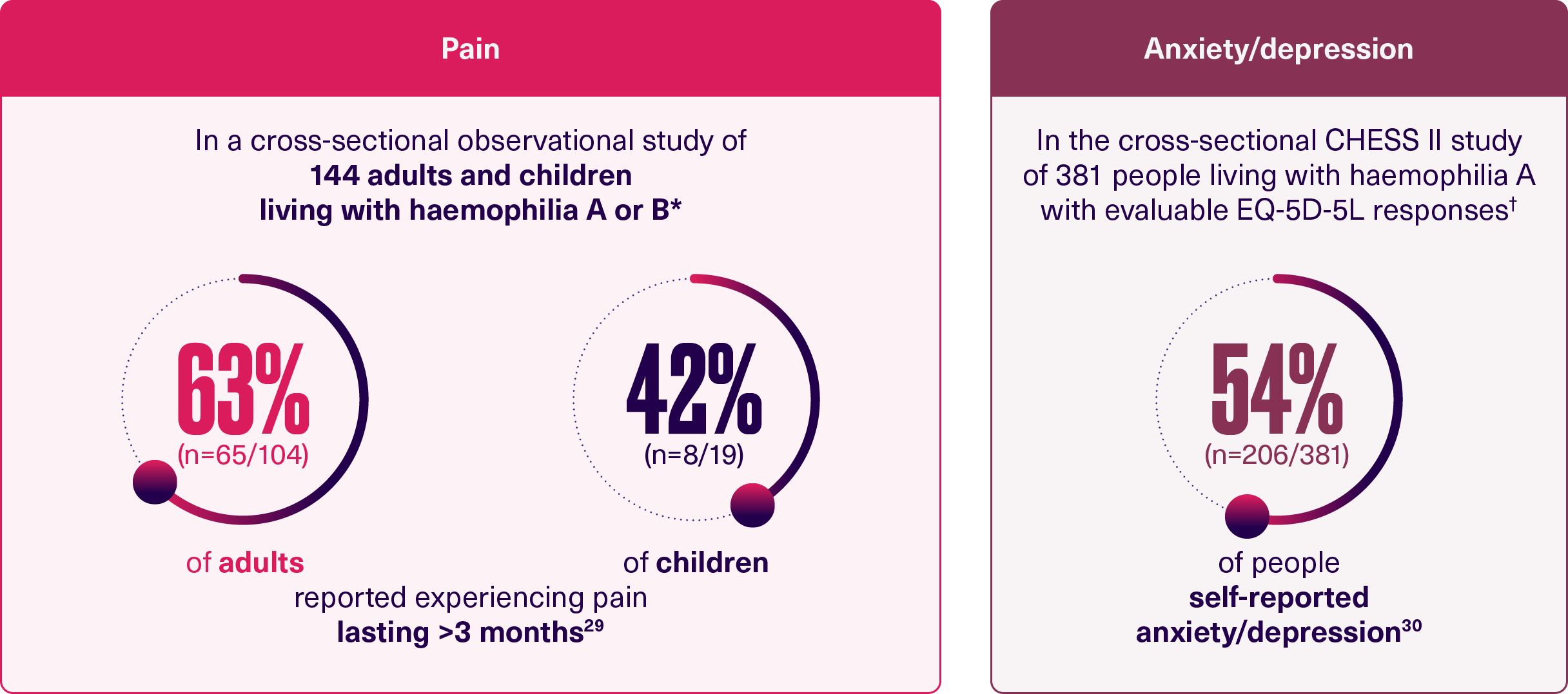
*National study assessing the prevalence, characteristics and impact of pain among Portuguese patients with haemophilia A or B of all ages. Children were aged 1–9 years old. Among those experiencing pain, 31 of 82 adults (37.8%) and 9 of 13 children (69.2%) were receiving prophylaxis.29 †Real-world analysis among adults with haemophilia A of any severity without inhibitors, evaluating the prevalence of anxiety and depression and the congruence in their reporting between patients and their treating physicians. Data were drawn from the CHESS II 12-month retrospective study across eight European countries. Data reported are from patients with some anxiety/depression and an EQ-5D-5L ≥2 (n=206). Of the 206 patients, 91 (44%) were receiving prophylaxis, 80 (39%) were treated on-demand, and 35 (17%) had no recent FVIII treatment. 21 (10%), 48 (23%) and 137 (67%) had mild, moderate and severe haemophilia A, respectively.30
Could targeting FVIII levels in the non-haemophilia range (>40 IU/dL)31 drive better patient outcomes?
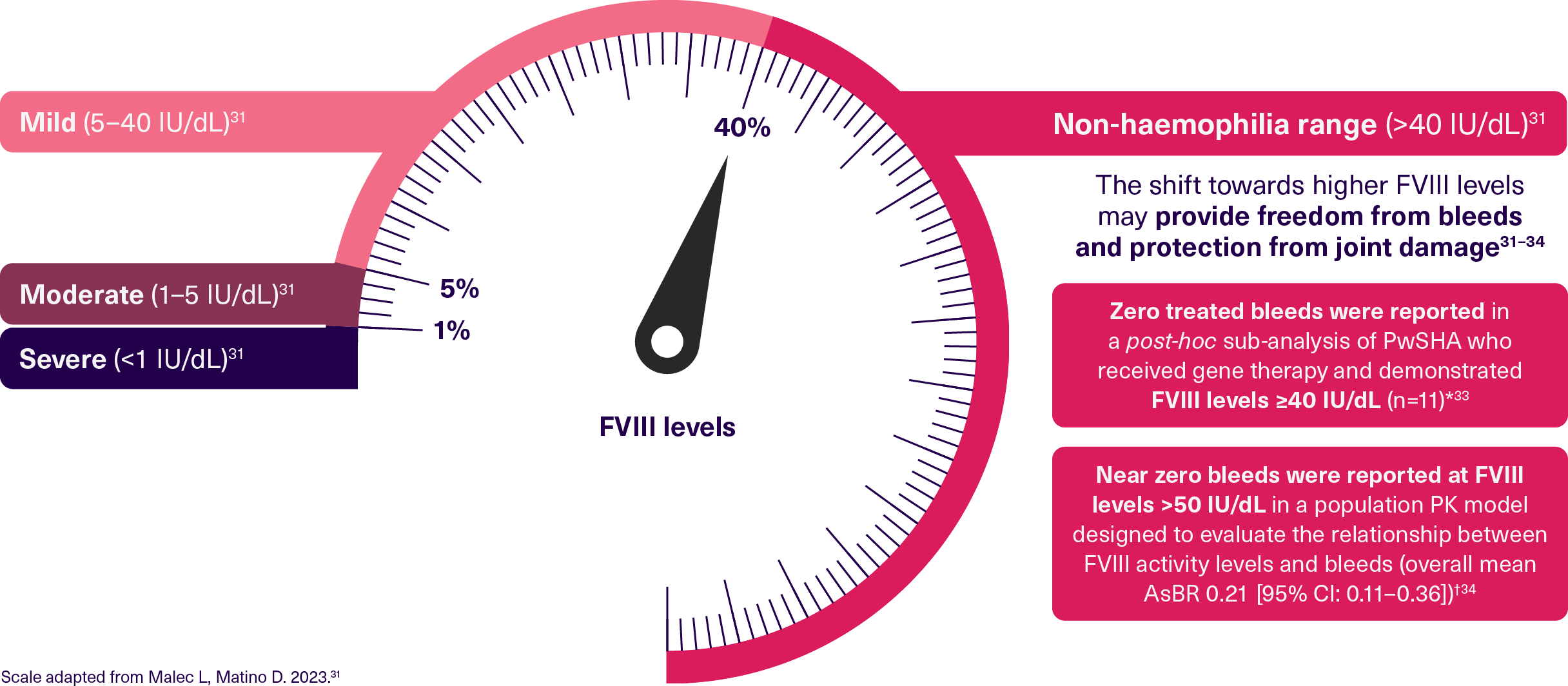
*Patients treated with valoctocogene roxaparvovec for three years who had FVIII activity ≥40 IU/dL at Week 156. Zero treated bleeds recorded at Year 2 and Year 3. Patients were male, aged >18 years with SHA (FVIII ≤1 IU/dL). Predefined efficacy outcome (N=112): mean ABR for treated bleeds was 0.8 (SD: 2.3) bleeds/year and mean change from baseline in ABR for treated bleeds was −4.0 (95% CI: −5.2–−2.8; p<0.0001) bleeds/year during the entire post-prophylaxis period, an 82.9% reduction from baseline.33 †Data from three clinical trials (adults, adolescents and paediatric PwSHA) were combined with dosing data and information on bleeding from patients’ diaries (N=231). Each patient’s time on prophylaxis was divided into five categories of predicted activity (0-1%, >1-5%, >5–15%, >15–50%, and >50%). Exposure time, mean FVIII activity, and number of bleeds were calculated for each activity category, and ABRs estimated using negative binomial regression and a parametric model.34
ABR, annualised bleeding rate; AsBR, annualised spontaneous bleeding rate; AF, atrial fibrillation; CI, confidence interval; EHL, extended half-life; EQ-5D-5L, EuroQol system measuring 5 dimensions: mobility, self-care, usual activities, pain/discomfort and anxiety/depression with 5 levels from no problems to extreme; FVIII, factor VIII; HAS-BLED, hypertension, abnormal renal/liver function, stroke, bleeding history or predisposition, labile international normalized ratio [INR], elderly [age ≥65 years], drugs/alcohol concomitantly; HCP, healthcare professional; ICH, intracranial haemorrhage; MRI, magnetic resonance; NFT, non-factor treatment; PK, pharmacokinetic; PwHA, people with haemophilia A; PwSHA, people with severe haemophilia A; SD, standard deviation; SHA, severe haemophilia A; SHL, standard half-life.
This content is focused on treatment diagnosis, disease management and its challenges. There is no intent to connect it with ALTUVOCT data and its potential use.
1. Andersson N, et al. Haematologica. 2025;110:914–922. 2. Zanon E, et al. J Clin Med. 2022;11:1969. 3. Chowdary P, et al. Res Pract Thromb Haemost. 2022;6:e12760. 4. Geller E, et al. Pediatric Blood and Cancer. 2024;0:e31456. 5. Guillet B, et al. Thromb Haemost. 2021;121:287–296. 6. Sanofi. Hemophilia Life Stages and Changes Global Survey Fact Sheet 2023. Available at: www.sanofi.com/assets/dotcom/content-app/
articles/your-health/global-hemophiia-survey-captures-the-voice-of-patients-caregivers-and-providers/Sanofi-1.pdf. Accessed June 2026. 7. Daffunchio C, et al. Thromb Res. 2023;226:86–92. 8. Mehta P, Reddivari AKR. Hemophilia. 2023. Available at: https://www.ncbi.nlm.nih.gov/books/NBK551607// Accessed June 2026. 9. Wilkins RA, et al. BMJ Open. 2022;12:e052358. 10. De la Corte-Rodriguez H, et al. Haemophilia. 2022;28:138–144. 11. Fornari A, et al. Haemophilia. 2024;30(2):449–462. 12. Chowdary P, et al. TH Open. 2025;9:a26219749. 13. Levy-Mendelovich S, et al. J Clin Med. 2021;10:4303–4312. 14. Di Minno D, et al. Haemophilia. 2013;19(3):167–173. 15. Srivastava A, et al. Haemophilia. 2020;26(Suppl 6):1–158. 16. Mancuso ME, et al. Haemophilia. 2023;29:619–628. 17. Gringeri A, et al. Haemophilia. 2014;1:459–463. 18. Van Bergen EDP, et al. Haemophilia. 2023;29:1580–1588. 19. Kotsiou N, et al. Pharmacy (Basel). 2025;13(1):16. 20. Pulles AE, et al. Pharmacol Res. 2017;115:192–199. 21. van Vulpen LFD, et al. Haemophilia. 2021;27 Suppl 3(Suppl 3):96–102. 22. Auerswald G, et al. Blood Coagul Fibrinolysis. 2016;27(8):845–854. 23. Ucero-Lozano R, et al. BMC Musculoskelet Disord. 2021;22(1):448. 24. Cohen O, et al. Res Pract Thromb Haemost. 2023;7(6):102178. 25. Dargaud Y, et al. Blood Rev. 2025;74:101304. 26. Seuser A, et al. Blood Coagul Fibrinolysis. 2018;29(6):509–520. 27. Strauss A, et al. ISTH 2025 Academy; PB1457. 28. Nicholson HJ 3rd, et al. Appl Sci (Basel). 2024;14(14):6292. 29. Pinto PR, et al. Pain Med. 2020;21:458–471. 30. Grazzi EF, et al. Haemophilia. 2024;30:743–751. 31. Malec L, Matino D. Haemophilia. 2023;29(6):1419–1429. 32. Chowdary P, et al. J Thromb Haemost. 2020;120:728–736. 33. Madan B, et al. J Thromb Haemost. 2024;22(7):1880–1893. 34. Tiede A, et al. Haematologica. 2021;106:1902–1909. 35. ALTUVOCT UK Summary of Product Characteristics. 36. ALTUVOCT EU Summary of Product Characteristics.
In the UK, ALTUVOCT (efanesoctocog alfa) is indicated for the treatment and prophylaxis of bleeding in patients 2 years and above with severe or moderate haemophilia A (≤5% endogenous plasma factor VIII activity). There are limited data in paediatric patients <2 years of age.35
In Ireland, ALTUVOCT (efanesoctocog alfa) is indicated for the treatment and prophylaxis of bleeding in patients with haemophilia A (congenital factor VIII deficiency). ALTUVOCT can be used for all age groups.36
| ▼ This medicine is subject to additional monitoring. This will allow quick identification of new safety information. Healthcare professionals are asked to report any suspected adverse reactions. Adverse events should be reported. Reporting forms and information can be found, for United Kingdom: via the Yellow Card Scheme at www.mhra.gov.uk/yellowcard or search for MHRA Yellow Card in the Google Play or Apple App Store. For Ireland: via HPRA Pharmacovigilance, website www.hpra.ie. Adverse events should also be reported to Swedish Orphan Biovitrum Ltd by email at [email protected] or by calling +44 (0) 800 111 4754. |