


Moving towards normalised haemostasis
New studies suggest that higher target FVIII levels are necessary to prevent clinical and subclinical bleeding in patients with hemophilia.1 According to current WFH guidelines, FVIII levels of 3-5% or higher are the target for minimizing bleeding risk. However, factor levels <40% define the range of mild hemophilia, so only levels above 40% allow the non-hemophilic range to be achieved.2
Despite advances in treatment and increased health equity for people with hemophilia today, there are still unmet needs that impact quality of life.1
Higher factor levels have been shown to be associated with a lower risk of bleeding and improved joint health and quality of life.3-9
ALTUVOCT® (efanesoctocog alfa) maintained FVIII levels within or close to the normal range for most of the week.10
The hemophilia community drives new goals for patient outcomes
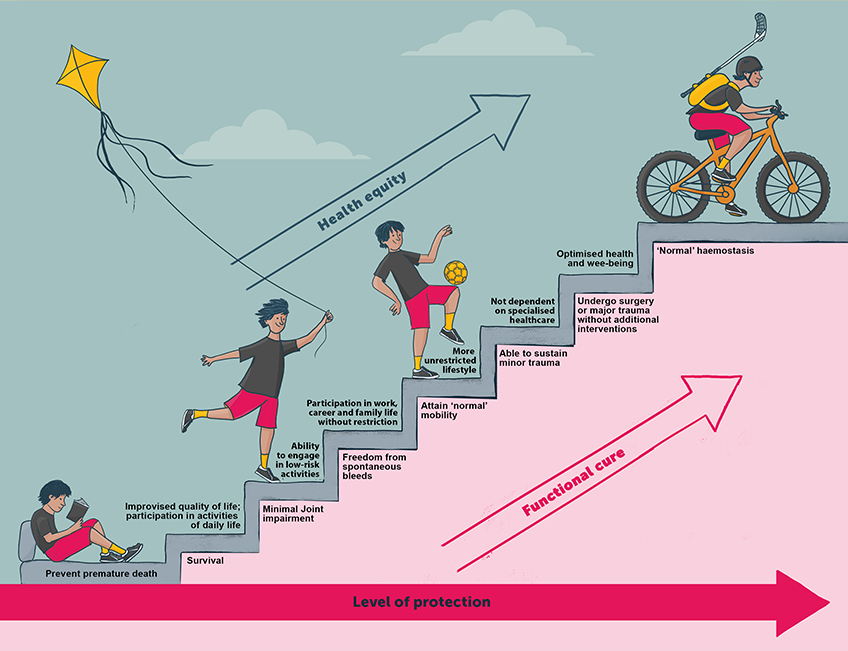
Figure adapted from Skinner MW, et al. Haemophilia, 2020; 26:17-24, reproduced BAJO cc-by-nc LICENCIA 20208
Possibility of normalization of hemostasis leading to health equity between people with and without hemophilia A8
References
WFH: World Federation of Haemophilia; FVIII: factor VIII
- Malec L, Matino D. Haemophilia 2023 Nov;29(6):1419-1429.
- Srivastava A et al. Haemophilia 2020, vol. 26, p. 1-158.
- Germini F et al. J Thromb Haemost 2022 Jun;20(6):1364-1375.
- Tiede et al. Haematologica 2021 Jul 1;106(7):1902-1909.
- Klamroth et al. Blood 2021 Apr 1;137(13):1818-1827.
- Valentino LA et al. Haemophilia 2016 Jul;22(4):514-20.
- Gooding R et al. J Blood Med 2021 Apr 1:12:209-220.
- Skinner MW et al. Haemophilia 2020 Jan;26(1):17-24.
- Chowdary P et al. Thromb Haemost 2020 May;120(5):728-736.
- von Drygalski A et al. N Engl J Med 2023;388(4):310-318