


MODE OF ACTION
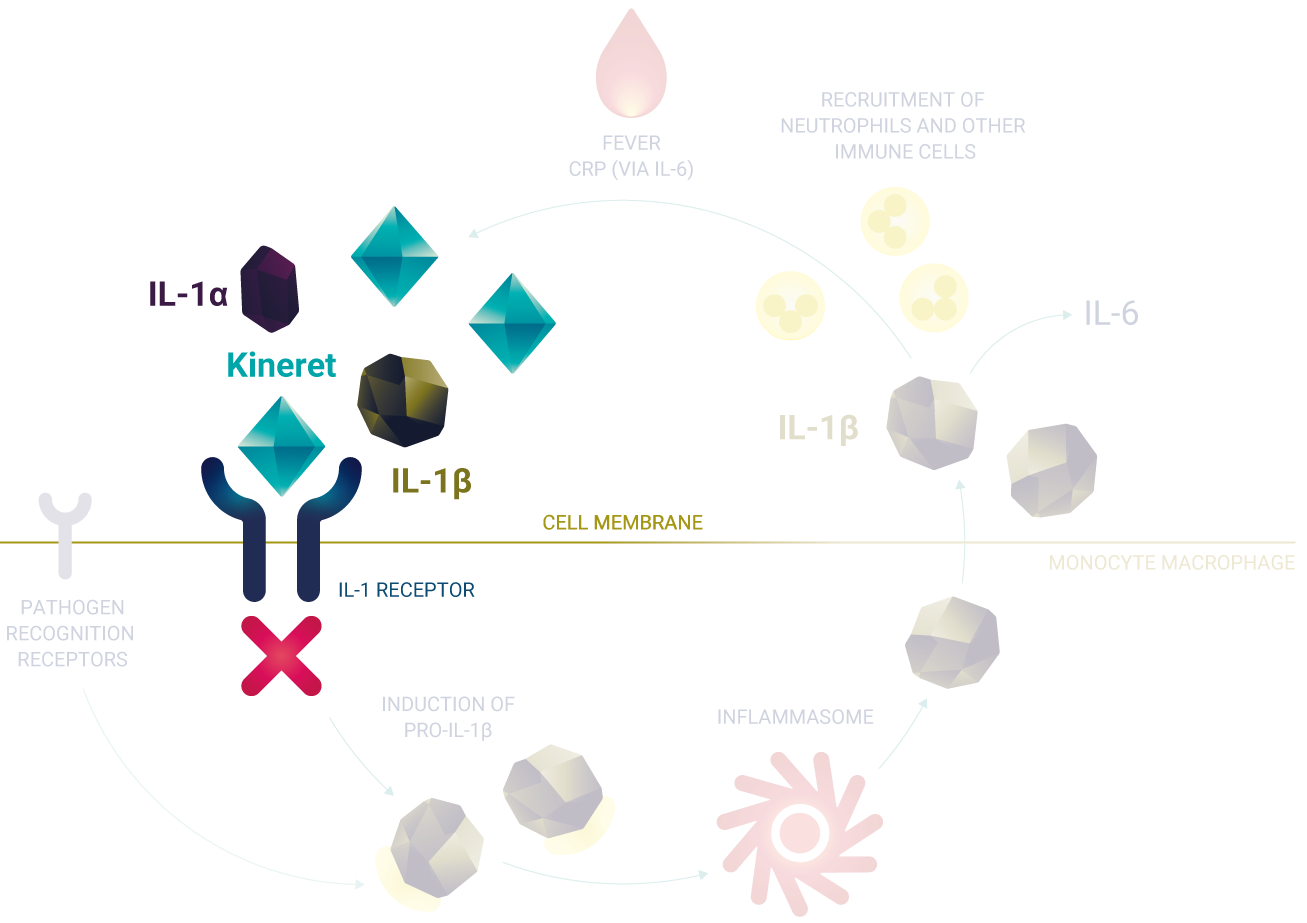
Kineret is a targeted treatment that neutralises the biological activity of both IL-1α and IL-1β1
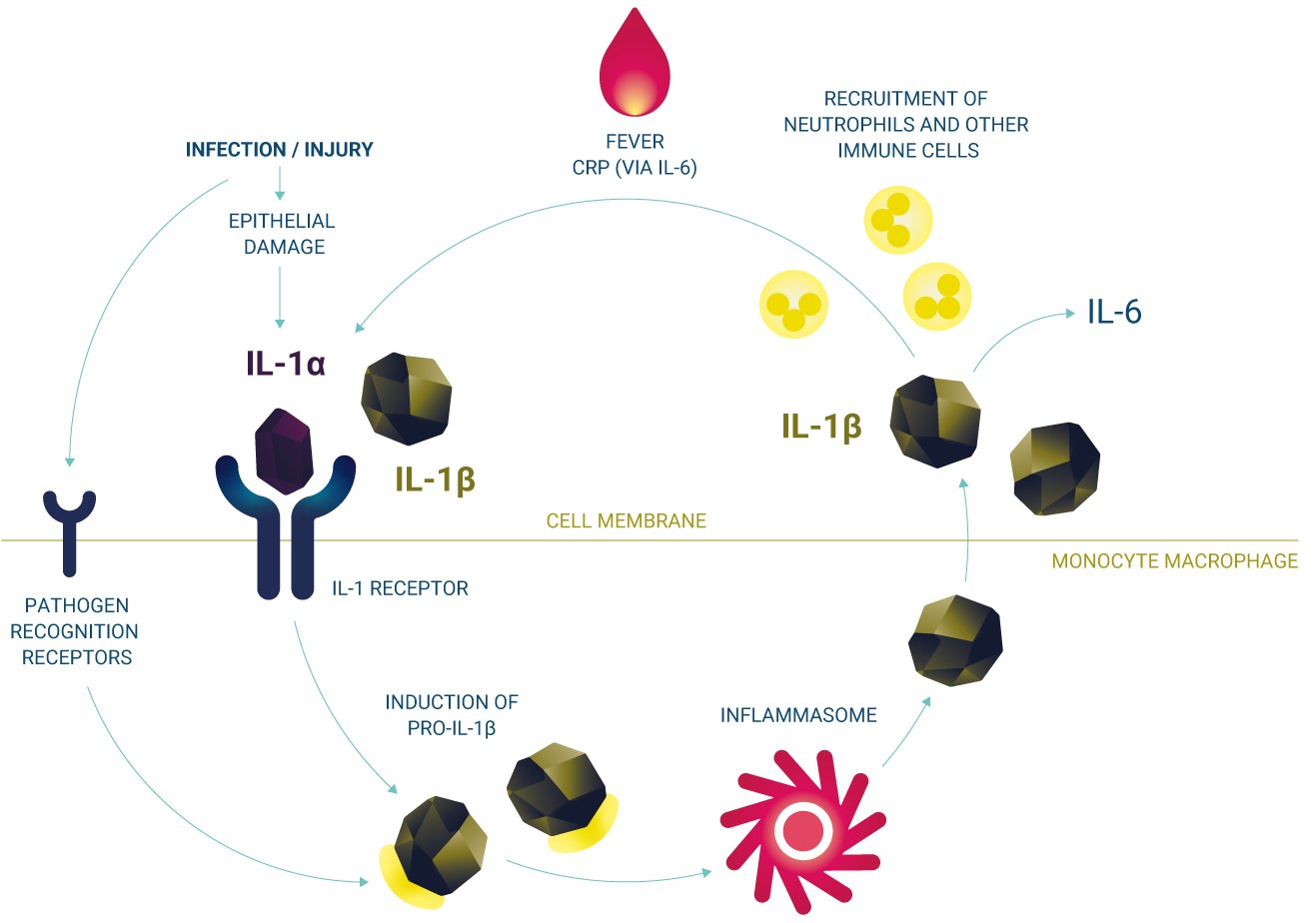
Kineret is a recombinant version of the naturally occurring IL-1 receptor antagonist (IL-1Ra). Kineret acts by competitively inhibiting the biological activity of interleukin- 1α (IL-1α) and interleukin-1β (IL-1β), preventing both cytokines from attaching to the IL-1 receptor (IL-1R1) and initiating downstream signalling cascades.1,2 By blocking the interaction between IL-1α/IL-1β and IL-1R1, Kineret interrupts IL- 1-mediated inflammatory processes and alleviates the signs and symptoms of conditions characterised by excessive or dysregulated IL-1 responses.2
Approved indications for Kineret1
Rheumatoid Arthritis (RA) In adults for the treatment of the signs and symptoms of RA in combination with methotrexate, with an inadequate response to methotrexate alone.
COVID-19 Treatment of COVID-19 in adult patients with pneumonia requiring supplemental oxygen (low- or high-flow oxygen).
Cryopyrin-Associated Periodic Syndromes (CAPS) Neonatal-Onset Multisystem Inflammatory Disease (NOMID) / Chronic Infantile Neurological, Cutaneous, Articular Syndrome (CINCA) - Muckle-Wells Syndrome (MWS) and Familial Cold Autoinflammatory Syndrome (FCAS)
Familial Mediterranean Fever (FMF) Kineret should be given in combination with colchicine, if appropriate.
Still’s Disease Adults, adolescents, children and infants aged 8 months and older with a body weight of 10 kg or above for the treatment of Still’s disease, including Systemic Juvenile Idiopathic Arthritis (SJIA) and Adult-Onset Still’s Disease (AOSD).1
See Kineret Prescribing information for summary of product characteristics for full prescribing and safety information
FAST ONSET
This is fast onset and short half life
Kineret has high absolute bioavailability after subcutaneous administration; maxi- mum plasma concentrations are reached within 3 to 7 hours and the terminal eli- mination half-life is 4 to 6 hours. Kineret induces a rapid resolution of systemic features such as fever, rash, and elevation of acute phase reactants.1
Safety
Please refer to current SmPC for more information about the safety and efficacy of Kineret.
Utvalgte advarsler og forsiktighetsregler1
Hepatiske hendelser
I kliniske studier har det blitt observert forbigående økning i leverenzymer. Rutinemessig testing av leverenzymer i løpet av den første måneden bør vurderes, særlig hvis pasienten har predisponerende faktorer eller utvikler symptomer som antyder leverdysfunksjon.
Alvorlige infeksjoner
Kineretbehandling skal ikke initieres hos pasienter med aktive infeksjoner. Med nøye overvåking kan behandlingen med Kineret fortsettes også ved en alvorlig infeksjon. Behandling med Kineret for covid 19 kan fortsette til tross for (sekundære) infeksjoner.
Nøytropeni
Kineret bør ikke initieres hos pasienter med nøytropeni (ANC < 1,5 x 10⁹/l).
Legemiddelreaksjon med eosinofili og systemiske symptomer (DRESS)
Ved bruk etter markedsføring er legemiddelreaksjon med eosinofili og systemiske symptomer (DRESS) rapportert i sjeldne tilfeller hos pasienter behandlet med Kineret, hovedsakelig hos pediatriske pasienter med Stills sykdom-systemisk juvenil idiopatisk artritt (SJIA)
Annet
Varier injeksjonssted for å unngå tegn og reaksjoner på injeksjonsstedet.
Utvalgte bivirkninger, pris og refusjon1
Svært vanlige:
Reaksjon på injeksjonsstedet
Hodepine
Økt blodkolesterol
Vanlige:
Nøytropeni
Trombocytopeni
Alvorlige infeksjoner.
Pris og refusjon
Varenummer: 418642
Styrke: 100mg/0,67 ml
Pakning: 7 x 0,67 ml (ferdigfylt sptøyte)
Pris (AUP): 2875,30
Refusjon: H-resept, R.gr.: C
Sist endret:
Basert på SPC godkjent av DMP/EMA: 09/2025
PP-30287 10/2025
Dosering og administrering1
RA: Voksne inkl. eldre: Anbefalt dose er 100 mg 1 gang daglig
CAPS: Voksne inkl. eldre, ungdom og barn ≥8 måneder og ≥10 kg: Anbefalt startdose 1-2 mg/kg dag.
FMF og Stills sykdom: Anbefalt dose 100 mg/dag ved kroppsvekt ≥50 kg. Ved kroppsvekt <50 kg justeres dosen etter kroppsvekt, med startdose 1-2 mg/kg/dag. Hos barn med utilstrekkelig respons kan dosen økes opptil 4 mg/kg/dag.
Kineret skal gis subkutant i daglige injeksjoner.
How is Kineret administered?
- Kineret is given in a pre-filled syringe containing 100 mg of anakinra per 0.67 ml (150 mg/ml).1
- Kineret is given once daily as a subcutaneous injection.1
- Dosage depends on indication. In children, the dose is determined depending on body weight. Please refer to current SmPC.
How should Kineret be stored?
- Kineret should be stored in a refrigerator between 2°C and 8°C.1
- Kineret should not be frozen or shaken.1
- Kineret should be kept in its original carton and away from light.1
References
- Swedish Orphan Biovitrum AB (publ). Kineret summary of product characteristics [SmPC]. Latest version available from: https://www.ema.europa.eu/en/documents/ product-information/kineret-epar-product-information_en.pdf
- Cavalli G, Dinarello CA. Anakinra therapy for non-cancer inflammatory diseases. Front Pharmacol. 2018; 9:1157
- Cavalli G, Colafrancesco S, Emmi G, et al. Interleukin 1α: a comprehensive review on the role of IL-1α in the pathogenesis and treatment of autoimmune and inflammatory diseases. Autoimmun Rev. 2021;20(3):102763
- van de Veerdonk, F.L., Netea, M.G. Blocking IL-1 to prevent respiratory failure in COVID-19. Crit Care 24, 445 (2020).