
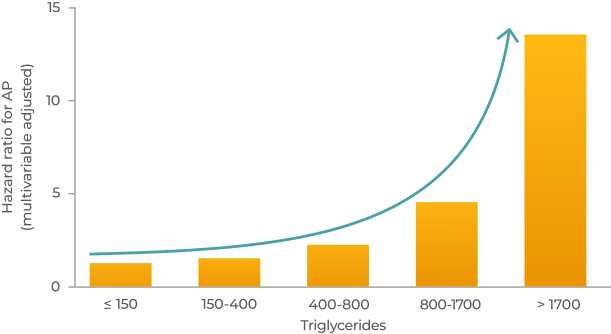
The acute pancreatitis critical threshold
- Risk of acute pancreatitis increases exponentially with increasing TG levels, with clinical significance above 880 mg/dL (10 mmol/L)1-3
- The severity and outcomes of acute pancreatitis are known to worsen with increasing TG levels4-6
Preventing the first episode of acute pancreatitis reduces the risk of subsequent events7
- HTG-associated acute pancreatitis is a medical emergency that may require hospitalisation and, in 5–8% of cases, can be fatal1,8,9
- Preventing an initial episode of acute pancreatitis in patients with sHTG is associated with a lower risk of recurrent episodes and of developing chronic acute pancreatitis7,10
24%
Once a parient with sHTG has had an episode of AP, their risk for a second can be as high as 24%7
49%
After 2 or more episodes, the risk for another can increase to nearly 49%7
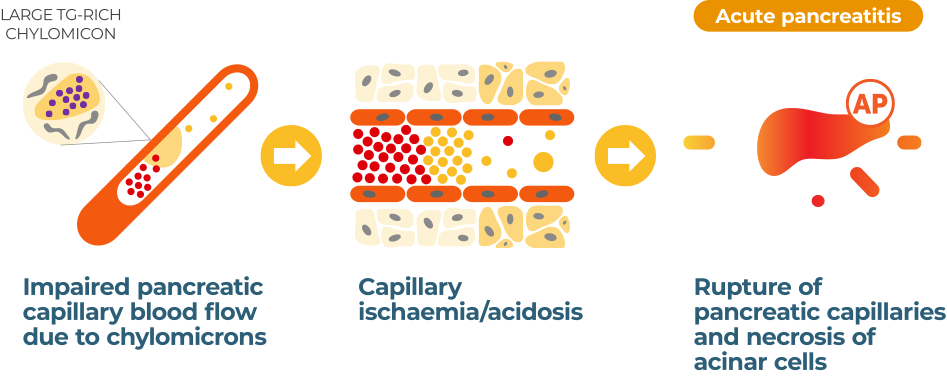
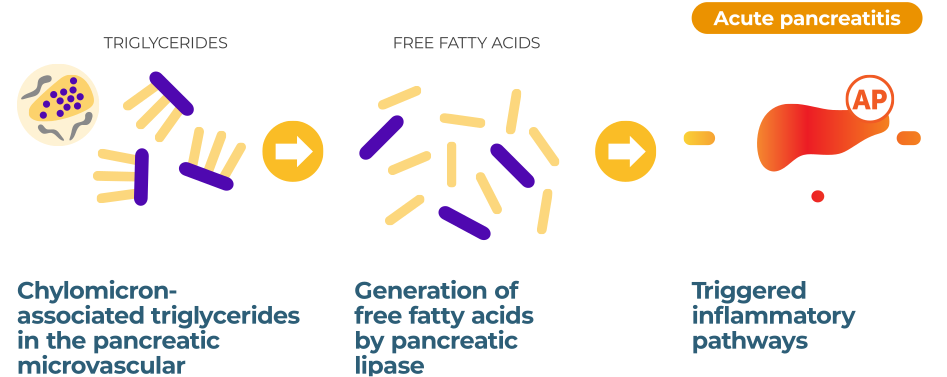
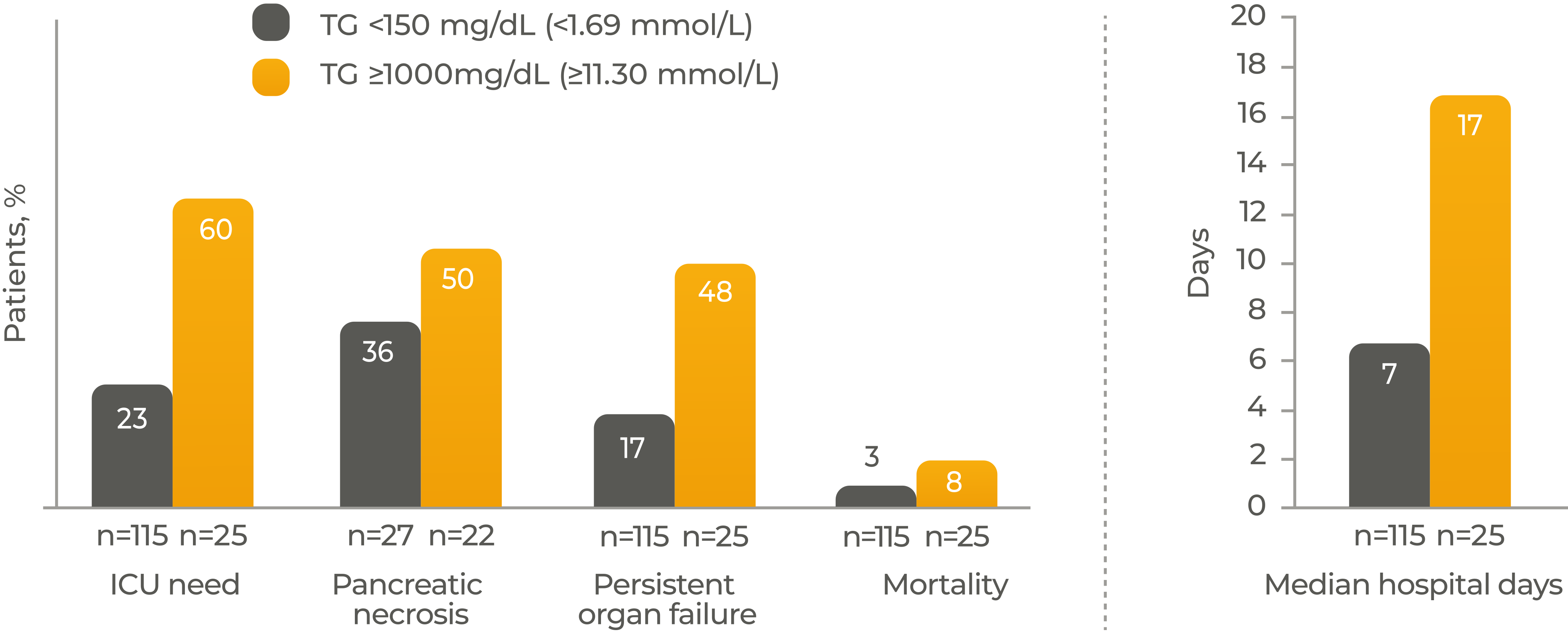
Clinical outcomes of HTG-associated acute pancreatitis worsen with increasing TG levels:5
Risk of clinical outcomes of HTG-related acute pancreatitis at different TG levels (Odds Ratio [95% CI])5
| TG level (mg/dL) | Persistent organ failure (POF) | Multiple organ dysfunction syndrome (MODS) | Pancreatic necrosis | Newly diagnosed diabetes mellitus | Mortality |
| 500–1000 | 1.48 [0.84, 2.61] | 1.29 [0.46, 3.57] | 1.27 [0.69, 2.34] | 3.66 [1.54, 8.70] | 1.92 [0.62, 5.99] |
| ≥1000 | 2.92 [1.78, 4.77] | 3.89 [1.77, 8.56] | 1.80 [1.06, 3.04] | 5.11 [2.39, 10.94] | 4.02 [1.55, 10.46] |
- Need for hospitalisation and long-term consequences of acute pancreatitis put serious economic burden on healthcare systems15-18
Guidelines recommend action to prevent acute pancreatitis
- European and American guidelines recommend treatment of elevated TG levels to prevent acute pancreatitis19-21
- Preventing an initial episode of acute pancreatitis in patients with severely elevated TGs is associated with a lower risk of recurrent episodes and of developing chronic pancreatitis7,10
- According to the 2019 ESC/EAS Guidelines for the management of dyslipidaemias: in sHTG ≥880 mg/dL (10 mmol/L), risk of pancreatitis is clinically significant and actions to prevent acute pancreatitis are mandatory19
- Triglyceride levels should be determined in all cases of acute pancreatitis, as sHTG may contribute even when the primary cause is obvious22


What is hypertriglyceridemia?
Different severities of hypertriglyceridemia (HTG) are classified across a spectrum...
References
1 Javed F, et al. J Clin Lipid. 2025;19:382-403.
2 Patel RS, et al. Cardiovascular Diabetology. 2022;21:102.
3 Moulin P, et al. Atherosclerosis. 2018;275:265-272.
4 Pothoulakis I, et al. Digestion. 2021;102(5):809-813.
5 Zhang R, et al. HPB (Oxford). 2019;21(9):1240-1249.
6 Nawaz H, Am J Gastroenterol. 2015;110(10):1497–1503.
7 Sanchez RJ, et al. Lipids in Health and Disease. 2021;20:72.
8 Vipperla, J Clin Gastroenterol 2017;51:77–85.
9 Subramanian S, Eur J Intern Med. 2025 Dec;145:106648.
10 Gagyi EB, et al. Ther Adv Gastroenterol. 2024;17:17562848241258671.
11 Chyzhyk V, Brown AS. Trends Cardiovasc Med. 2020;30(2):80-85.
12 Valdivielso P, et al. Eur J Intern Med. 2014;25(8):689-694.
13 Berglund L, et al. J Clin Endocrinol Metab. 2012;97(9):2969-2989.
14 Bálint ER , et al. Sci Rep. 2020;10(1):17936.
15 Kessler AS, et al. J Clin Lipidol 2025; S1933-2874(25)00268-5.
16 Pahomeanu MR, et al. Healthcare (Basel). 2023;11(18):2482.
17 Andersson B, et al. Scand J Gastroenterol. 2013;48(12):1459-65.
18 Hall T, et al. J Eval Clin Pract. 2014;20(3):203-207.
19 Mach F, et al. European Heart Journal. 2020;41(1):111-188.
20 Blumenthal RS, et al. Circulation. 2026;153(17):e1154–e1276.
21 Newman C, et al. J Clin Endocrinol Metab. 2020;105(12):dgaa674.
22 Laufs U, et al. Eur Heart J. 2020;41(1):99-109.